
How Medical Chronology Helps Attorneys Understand Complex Medical Records
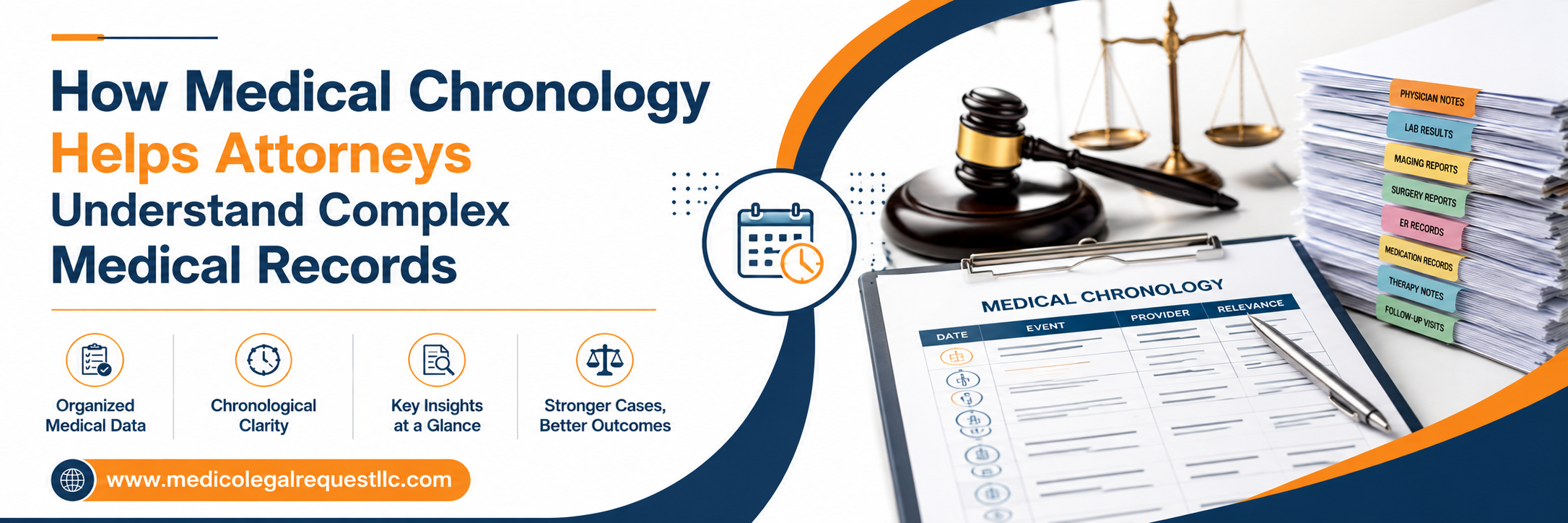
Medical records can contain hundreds or even thousands of pages covering years of treatment, multiple healthcare providers, diagnostic tests, medications, procedures, and follow-up visits. For attorneys handling personal injury, medical malpractice, workers’ compensation, or other healthcare-related cases, reviewing this information can be time-consuming and challenging.
A medical chronology provides a structured way to organize this information. By arranging important medical events in chronological order, attorneys can quickly understand the client's treatment history, identify significant developments, and evaluate how the medical evidence relates to the legal case.
------
What is a Medical Chronology?
A medical chronology is a chronological summary of a patient's relevant medical history. It organizes information from medical records according to dates and typically includes important details such as:
Dates of medical visits and treatments
Healthcare providers and facilities
Diagnoses and symptoms
Diagnostic tests and results
Medications
Surgical procedures
Treatment recommendations
Follow-up care
Changes in the patient's condition
Rather than requiring an attorney to repeatedly search through individual records, a well-prepared chronology provides a clear overview of the patient's medical journey.
------
Why Medical Records Can Be Difficult to Review
Medical records are not always organized in a way that makes legal review easy. Records may come from different hospitals, physicians, specialists, imaging centers, laboratories, and other healthcare providers.
Important information can also appear in different sections of a patient's chart. A diagnosis may be documented during one visit, while the related test result or treatment decision may appear weeks later in another record.
Attorneys must often connect these pieces of information to understand the complete story.
This is where a detailed medical chronology can provide significant value.
------
How Medical Chronology Helps Attorneys
1. Creates a Clear Medical Timeline
A chronology puts medical events into date order, making it easier to see how the patient's condition developed over time.
For example, an attorney may need to determine when an injury occurred, when symptoms first appeared, when diagnostic testing was performed, and when treatment began. A chronological timeline makes these events easier to identify and compare.
2. Reduces the Time Required for Record Review
Reviewing large medical files manually can consume valuable attorney and staff time. A professionally prepared medical chronology report can reduce the need to repeatedly search through lengthy records for important dates and events.
This allows attorneys to spend more time on case strategy, client communication, legal research, and other important responsibilities.
3. Helps Identify Gaps and Important Events
A chronology can make missing or unclear information easier to recognize.
For example, an attorney may notice that there is a significant period between two treatments, an unexplained change in medication, or a diagnostic test that requires further investigation.
Identifying these gaps early can help attorneys determine whether additional records or clarification may be necessary.
4. Connects Symptoms, Diagnoses, and Treatment
Medical conditions often develop through a series of events rather than a single appointment.
A medical chronology helps attorneys follow the progression from symptoms to examination, diagnosis, testing, treatment, and follow-up. This organized presentation can make complicated medical information easier to understand during case preparation.
5. Supports Case Analysis
Attorneys need to understand not only what happened but also when it happened.
A well-organized medical chronology can help attorneys analyze the relationship between an accident or alleged medical event and subsequent medical treatment. It can also provide a useful reference when preparing questions for medical experts, depositions, negotiations, or litigation.
6. Makes Large Medical Files More Manageable
Large medical records can be overwhelming. A concise medical chronology provides a roadmap through the records.
Instead of starting with hundreds of pages every time a particular event needs to be verified, attorneys can use the chronology to locate the relevant date, provider, diagnosis, or treatment and then return to the original record for detailed verification.
------
What Makes a Medical Chronology Useful?
Not every timeline provides the same level of value. An effective medical chronology should be accurate, organized, relevant, and easy to review.
It should distinguish important medical events without unnecessarily reproducing every detail contained in the original records. At the same time, significant information should not be omitted simply to make the chronology shorter.
The goal is to create a practical reference that helps attorneys understand the medical history while allowing them to trace important information back to the source records.
------
Medical Chronology and Litigation Preparation
Medical chronology can be particularly useful during different stages of litigation.
During initial case evaluation, a chronology can help attorneys quickly understand the client's treatment history and determine what additional information may be needed.
During discovery, it can help organize medical evidence and identify important dates, providers, and treatment events.
During deposition and expert preparation, attorneys can use the timeline to review the sequence of medical events and develop relevant questions.
During settlement negotiations, an organized medical history can make it easier to evaluate the progression of treatment and the medical evidence supporting the client's claims.
------
Professional Medical Chronology Services
Preparing a detailed medical chronology requires careful review of medical documentation and attention to dates, diagnoses, treatments, and clinical developments. For attorneys managing multiple cases, outsourcing this work can provide additional time and resources.
Professional medical chronology services can help law firms organize complex medical records into structured timelines designed for legal case review.
At Medico Legal Request LLC, our team reviews medical records and prepares organized medical chronologies to support attorneys and legal professionals. Our services can be customized according to the requirements and complexity of each case.
------
Conclusion
Complex medical records do not have to become a barrier to effective case preparation. A well-prepared medical chronology transforms scattered medical information into an organized timeline that attorneys can review more efficiently.
By providing a clear picture of symptoms, diagnoses, tests, treatments, and medical developments, a medical chronology can help attorneys better understand the medical evidence and focus their time on building their legal strategy.
If your law firm needs support reviewing and organizing complex medical records, professional medical chronology services can be a valuable addition to your litigation support workflow.
For more information about our medical chronology services or to request medical chronology samples, connect with us at info@medicolegalrequestllc.com.
------
Frequently Asked Questions
------
Why do attorneys need a medical chronology?
A medical chronology helps attorneys quickly understand complex medical records without having to repeatedly review large volumes of documentation. It can support case evaluation, litigation preparation, discovery, deposition preparation, and settlement discussions.
------
What information is included in a medical chronology?
Depending on the case requirements, a medical chronology may include dates of treatment, provider information, diagnoses, symptoms, diagnostic tests, test results, medications, procedures, treatment plans, follow-up visits, and significant changes in the patient's condition.
------
Can medical chronology services help with personal injury cases?
Yes. Medical chronologies can help organize the medical history associated with personal injury cases, making it easier to review injuries, treatment progression, diagnostic findings, procedures, and recovery.
------
Can medical chronologies be used for medical malpractice cases?
Yes. A detailed chronology can help attorneys organize the sequence of medical events and identify important diagnoses, treatments, procedures, and other documentation relevant to a medical malpractice case.
------
Can I see a medical chronology sample?
Yes. Attorneys and legal professionals can request medical chronology samples to understand how medical information can be organized into a clear and easy-to-review timeline.
------
Can medical chronology services be customized?
Yes. Medical chronology reports can be prepared according to the attorney's case requirements, preferred format, level of detail, and scope of review.
------
How can I request medical chronology services?
To request our medical chronology services, simply click the “File Upload” button on our website, create your free case management account, and submit your case request. Our team will review your request and assist you with the next steps.